Interactivated logo

Interactivated Growth Lab:
Tech, Design & Business Insights

Explore our expert articles on scaling startups, product development, digital transformation, and cutting-edge technologies reshaping industries

Interactivated solutions blog banner

VR vs. AR vs. Mixed Reality: Which One Is Right for Your eCommerce?

Mixed reality (MR), augmented reality (AR), and virtual reality (VR) have revolutionized the way people interact with the virtual world. They’ve enhanced video games, but they’ve also enabled you to improve your eCommerce experience.

Harnessing these technologies for your company requires you to understand their features and differences. This entry will discuss the basics of VR, AR, and MR to help you determine which one you should incorporate into your business.

VR

Out of all these state-of-the-art innovations, your customers are probably most familiar with VR. This technology is completely immersive, filing the shoppers’ senses with virtual worlds and headsets. It makes them believe they’re part of a sphere separate from real life.

Through head-mounted displays (HMDs) or headsets, users can see computer-generated imagery (CGI) and hear audio from your virtual space. Some applications merely allow them to explore different areas. Others enable consumers to manipulate digital objects.

Businesses redefine this technology, finding creative ways to immerse potential shoppers by introducing them to digital objects and worlds. It’s especially popular among companies that encourage their customers to perform the following activities:

  • Enjoy virtual showrooms
  • Explore real estate
  • Visit spaces digitally because doing so in real life would be impossible.

Some organizations also utilize VR to streamline marketing campaigns. They highlight products or services by showcasing their capabilities in mesmerizing virtual demonstrations.

VR

For instance, IKEA launched several VR stores in Morocco, Kuwait, and Jordan in 2017 within the corresponding physical shops. Customers visited these small VR-powered locations and leveraged the technology to purchase floor plan accessories. From there, they bought elements in-store or online.

VR is so effective because it accurately replicates the real-life shopping experience. With 360-degree views, customers examine your products from all angles to understand the proportions. This way, they don’t need to rely on lengthy product descriptions, which can be a problem due to language barriers.

Ultimately, VR increases your online consumers’ confidence when implemented correctly. This leads to a higher conversion rate and customer satisfaction.

AR

AR is the addition of digital data to your customers’ environment. Unlike VR, it uses an existing landscape and incorporates new details into it.

In other words, it augments the world. It doesn’t create new areas – it just adds artificial elements to make the experience more vivid.

Pokémon Go is probably the most famous example of AR. Users can play it while walking in the park, looking at real-life environments through their smartphones. Digital characters are overlaid in certain places to augment the experience.

The best thing about AR is that it provides a better connection. Rather than engaging your consumers with a straightforward website, you include cutting-edge technology to make the eCommerce journey more immersive.

Plus, you can use AR to encourage your shoppers to interact with each other. Considering that most people hear about new offerings from family and friends, this can be a massive boon for your sales. Providing your users with the ability to communicate and share their opinions elevates their digital experience. Plus, this feature has been present for quite a while through multiplayer games and chatrooms, so you won’t overwhelm your customers.

For instance, suppose you’re holding a virtual event to promote a product. The AR aspect lets your users take a closer look at your offerings while talking with other attendees or the sales team. The result is a more relatable experience that piques your consumers’ interest and persuades them to buy your stuff.

Best of all, you don’t have to rely on real-time interactions only, particularly when it comes to user reviews. If you have headless systems, your content can easily be repurposed by transferring it to the AR realm. Your shoppers can access relevant information by checking out a product in a virtual sphere. This way, they immediately see how other people feel about your offering.

Another great thing about AR is that it lets you gamify content by taking advantage of its entertainment features. While the technology is primarily designed for video games, you don’t have to abandon the reputation. It can serve eCommerce goals perfectly by introducing your products in familiar contexts.

You might have already gamified your store with various elements, like daily deals and loyalty programs. The principle is the same with AR. You can reward some users with points for interacting with a virtual environment. This attracts more customers to the shop, which can increase your sales.

You can also personalize the experience using avatars. This is an effective tactic if you’ve already set up social features that enable customers to interact with each other. By performing specific actions, users unlock exciting customization elements for their avatars. The result is higher engagement.

The possibilities are endless with AR. Just take a look at what other stores are doing to raise interest in their products and services. For instance, some businesses improve access to their daily deals using AR-powered mediums, including virtual scratch-off cards for discount codes. The easiest way to expand this feature to your AR environment is to incorporate physical interactions. In other words, your users are required to make the necessary scratch-off motion to obtain discounts.

AR

Mini-games are an excellent option too. They reinvigorate your eCommerce environment and make it memorable, which advertises deals more successfully.

In a nutshell, you can apply AR to your eCommerce with tablets, smartphones, and many other devices. It lets consumers interact with information and virtual objects. Most companies use it to show shoppers how a product looks in a specific place, like the buyers’ homes. It enables them to try the item before buying it, making them more confident in their purchase.

AR is incredibly advantageous, but it doesn’t always have the same for. There are several types of this technology that offer various capabilities.

Marker-Based AR

Marker-based (recognition-based or image recognition) AR detects objects (markers) before your camera and provide details about the items on a screen. Upon detecting markers, the platform replaces the markers with a 3D model. As a result, your customers can view your products in greater detail from different angles.

Markerless AR

On the other side of the spectrum lies markerless AR. Unlike marker-based solutions, this technology isn’t triggered by specific real-world objects. Instead, your shoppers can place virtual objects anywhere they want. This allows them to take a closer look at the features by moving and rotating them.

Projection-Based AR

The third type of AR is projection-based AR. It projects artificial light onto a physical surface and sometimes enables your customers to interact with it. The holograms in Star Wars and other sci-fi movies are the most common examples.

Location-Based AR

Finally, you can opt for location-based AR. It’s a form of markerless technology that utilizes geographic locations to display your digital content in specific places. Pokémon Go relies on this type of AR.

Location-Based AR

MR

MR is similar to AR. Both technologies combine the real and virtual world, but MR does so differently. Namely, it enables users to manipulate both physical and virtual objects. Your customers can interact with digital products with tools, hands, or any other means they use in real life. They can rely on specialized devices to bridge the gap between the two spheres. For instance, smart glasses and headsets are perfect for MR-powered environments.

As MR is the most recent immersive solution, it’s not as popular as AR and VR. However, this may change very soon. Some of the most renowned companies, like Lenovo, Acer, and Microsoft, are developing platforms that revolve around MR. As they polish this technology, you can expect more capabilities for your eCommerce application.

Nowadays, most organizations rely on MR to prototype products in a virtual space, improve design modeling, and engineer new offerings. Take Ford as an example. The company uses MR to create new vehicles with the cutting-edge headset called Microsoft HoloLens. Potential customers can check out the models in an immersive environment to ensure they’re buying the right car.

Following this try-before-buy principle, MR is bound to be even more prevalent in eCommerce. It can be a perfect asset for enabling your consumers to get a feel for your product before purchasing it. Once your shoppers arrive in your store and view your offering, the technology can help them physically manipulate your assortment. Accordingly, they can determine whether or not the item “feels” right in their hands.

With smart glasses or other gadgets, your customers can also browse your physical store while checking out different virtual interfaces and components. This combines both spheres into one. The two worlds not only co-exist but also complement each other to create a mesmerizing experience. The only downside is that it may take a while for MR-based platforms to offer the same versatility as AR and VR.

What’s the Verdict?

The choice between VR vs. AR is simple. If you have existing eCommerce infrastructure you want to enhance with powerful technology, go for AR. If you want to create a new environment for your customers to test your products, VR is your best option. But if you wish to combine both, you can’t go wrong with MR.

April 30, 2023
Interactivated solutions blog banner

Implementing AR Into the eCommerce Experience: Practical Examples

Your customers’ expectations grow as they buy more and more products and services. They require an interactive experience to understand your offerings better. That’s where augmented reality (AR) comes into play.

AR can add tremendous value to your clients’ eCommerce journey. This article will explain how by listing the most popular examples of AR implementation.
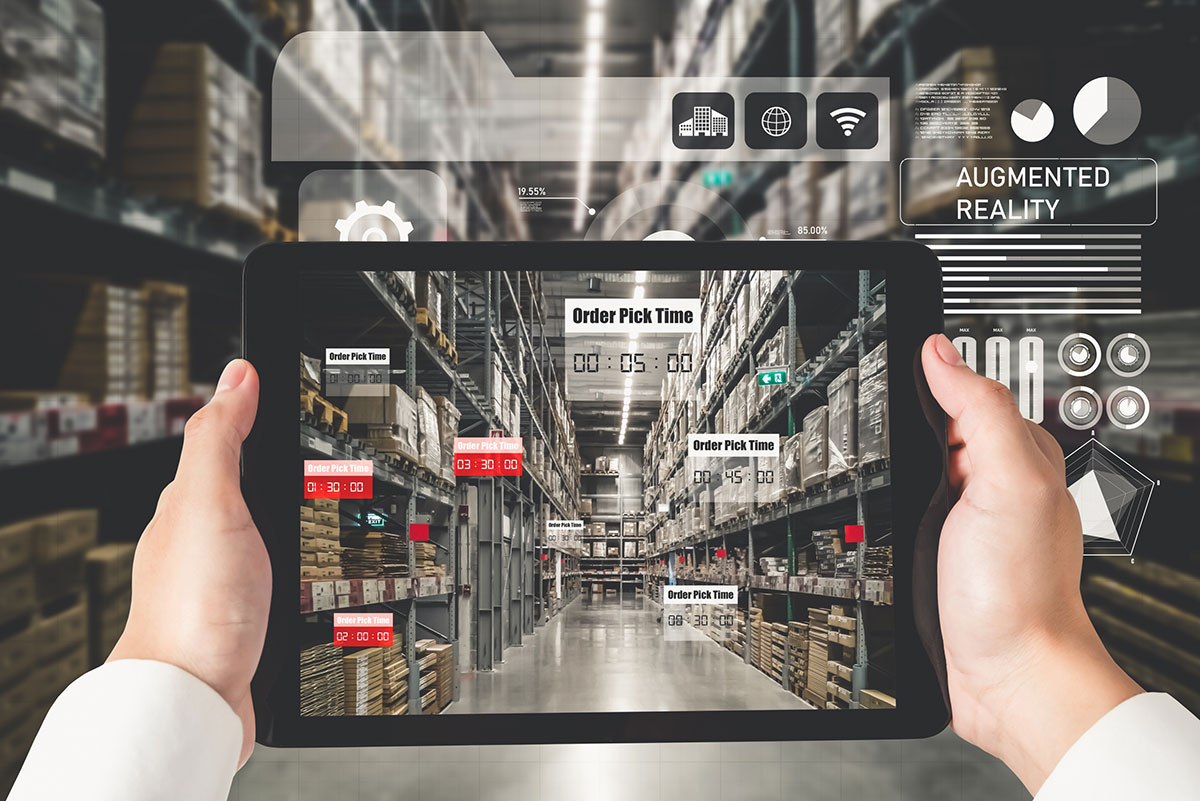
What Are the Most Famous Examples of AR in the eCommerce Experience?

AR is a staple of many eCommerce platforms. It’s helped numerous brands take their website experience to a whole new level.

Converse Sample

Converse is one of the first companies that have applied AR to boost eCommerce sales. They developed the Sampler app that enables clients to try on various pairs of shoes. It also has an integrated purchasing feature that allows customers to buy products seamlessly.

Many other brands have followed in the footsteps of Converse, taking a similar approach to selling sneakers online. The sales process is challenging for any company, especially in the digital sphere, which is why Sampler is even more impressive. It allows for many personal details, – including preferred designs and the ideal shoe size – that let customers view products from their perspective.

Sephora Virtual Artist

A few years ago, Sephora launched the Virtual Artist platform. It allows clients to virtually test a wide array of makeup items. Best of all, a customer can try the product on their own face for a more personalized experience.

Initially, customers had to upload selfies to check out different makeup products before buying them. Recent updates provide a real-time rendering of the items using the customer’s smartphone. Users can test expressions, and angles, and take photos to share with their friends.

Some makeup professionals consider this an inadequate way of matching a shade to a customer’s skin tone. However, the feature still allows users to easily test out options before purchase.

Sephora Virtual Artist

Nike’s SNKRS

Joining a community of rare sneaker aficionados can be incredibly stressful. Every year, fans vie for limited-edition Nike shoes, and sometimes, the enthusiasm escalates to a physical situation. The company wanted to prevent this trend by turning to AR.

Eventually, they came up with SNKRS. This isn’t a typical internet shop. Instead, it’s an AR experience that lets users unlock rare sneakers in NYC by taking pictures of stores or posters or visiting certain locations. Considering Nike’s popularity, this means limited kicks are only reserved for the most avid fans.

The company follows up the app with an annual SNKRS day. This is when Nike re-releases the hottest sneakers of the year to further streamline the shopping experience.

Gucci Virtual Shoes

Converse spearheaded the trend of trying on shoes digitally. As previously mentioned, many companies followed suit, and one of the most famous examples is Gucci.

They’ve made some of their products available only online. Customers can wear and buy them, but on the internet only. As a result, they can customize them with immersive features to create a unique pair of shoes.

This footwear is available on Gucci’s Sneaker Garage. It can also be worn on many compatible apps, such as VRChat and Roblox.

View in My Room by Houzz

Home redecorating and improvements are fun, but they can also be overwhelming. Customers need to ensure their floors match other parts of the house. Plus, they need to determine the right amount of material.

Houzz addresses these concerns by allowing their customers to lay out new floors using View in My Room. This AR-powered app lets customers choose from a vast collection of tiles to find a product that suits their abode perfectly. Once they pick the right design, they can change the tiles’ orientation to achieve the desired layout. Finally, the app calculates the number of squares the client needs to redo their floor.

The platform is an excellent choice for large projects. It lets users share 3D creations with contractors, family members, and friends. Therefore, they can consult other people on the best solution for their house.

Machine A

The coronavirus pandemic forced event organizers to reconsider how they engage with their customers through digital channels. In-person gatherings were frequently canceled at the last moment, which cost companies a lot of money. Businesses had to rise to the occasion and offer a virtual solution for various sectors, especially the fashion industry.

To that end, Machine A was developed. This virtual boutique lets shoppers check out the latest products from the current fashion season. It’s a digital-only setting that works great for remote customers. Even though the original version didn’t feature a shopping feature, it was quickly incorporated and further optimized the eCommerce experience.

Many famous companies integrated with the app due to its potential to plan future fashion events. For instance, Vogue utilized the platform to promote its collection at London Fashion Week. They hosted a seamless event, and audiences observed it from their smartphones.

The platform doesn’t have applications in the fashion world only. It can also be leveraged for electronics or motor shows. For example, Volkswagen took a similar approach to organizing one of their most recent motor shows. They used an AR app to display advanced vehicles digitally, allowing customers to tune in from anywhere in the world.

Amikasa

Amikasa is an AR eCommerce app that lets customers design their dream house with furniture from real-life brands. This makes it perfect for customers redesigning their place or moving into a new dwelling. It enables them to recreate their abode, change colors, and pick the most suitable elements for each room. As a result, they can see whether something fits the layout of the house or makes the area feel cramped. Visualizing the end result is much easier this way.

If customers are happy with the look of their new house, they can purchase products within seconds. The buying feature is streamlined and doesn’t overwhelm clients with unnecessary information.

Quiver

Optimizing the eCommerce experience requires you to cater to all ideal customers, including kids. Quiver is an excellent example of a child-friendly AR app. It’s a simple yet highly effective platform where young ones can download and print a huge array of coloring pages. Once a child has colored their picture, they can bring it to life through Quiver.

The end result is terrific. More and more kids are attracted to the app because it offers an engaging playing experience.

Shopping Lenses

Snapchat isn’t just an established social media platform. They also take business collaboration seriously. enhancing their eCommerce journey with Catalog-Powered Shopping Lenses. It allows brands to utilize AR at scale.

Shopping Lenses

This new platform combines the performance and personalization of AR with commerce catalogs to create immersive product visualizations. It displays multiple items from a brand’s catalog using just one lens. From there, the product information is pulled from a database and visually presented in a new window. Whenever the collection is updated, the changes are automatically shown to expedite the integration process.

Nike’s Gamification

Nike makes another appearance on our list with a different AR program. The company hosted a challenge in one of its NYC stores. Collaborating with Hovercraft, a cutting-edge technology provider, the shoe business set up an engaging gamified discovery center. Shoppers could interact with virtual wildlife while progressing through several AR-based tasks. They were accompanied by a revolutionary AR mascot wearing clothes from the All Conditions Gear collection.

The initiative was a resounding success. Both online and brick-and-mortar sales soared.

Walmart and Zeekit

Walmart has ramped up its AR functionality for its customers. The company recently integrated with Zeekit, an AR fitting room where users can try on various clothes and share their new attire with friends.

The corporation has also optimized AR features for employees. Walmart distributed the new Me@Walmart app to more than 700,000 workers. Each received a new smartphone that supports the platform, providing them with many state-of-the-art features. For instance, workers can now retrieve products from databases faster because it highlights which items are available.

Both Zeekit and Me@Walmart facilitate a better eCommerce experience. The employees can work in an improved, AR-supported environment while the customers enjoy higher immersion.

Salon

Amazon is known for engaging platforms, and one of the most impressive additions is Salon. This 1,500-square-foot space was opened in London in 2021 and was designed to test cutting-edge hairdressing technology. Shippers can try virtual colors and take advantage of the ultra-powerful point-and-learn functionality. It allows customers to point smartphones at a product to obtain relevant information, such as educational content and brand videos. The details appear on the users’ displays.

To purchase a product, all they need to do is scan the appropriate QR code, visit the information page, and finalize the transaction. The items are then delivered to the customer’s home.

Take Your Internet Shopping Features to New Heights

If you want to elevate your eCommerce functionality, there’s no going wrong with AR. Thousands of brands have implemented the technology to make their offerings more accessible to customers and boost sales. You can do the same. Determine what your current platform lacks and look for an app that will elevate the experience.

April 15, 2023
Interactivated solutions blog banner

Top Magento Themes for 2023

Permformance Comparisons

With the arrival of 2023, it is essential to keep up with the latest trends in e-commerce website development. Among the most critical aspects to consider are the Magento themes that can provide excellent performance, customization options, and affordability for your online store. In this post, we’ll explore multiple pertinent and notable themes. We will compare their performance optimization score, customization peculiarities, budget range, and pricing to help you choose the perfect theme for your e-commerce website.


  1. Luma

Luma is a boxed theme that comes with the standard distribution of the Magento2 core. Despite having good compatibility with third-party modules, its front-end stack is outdated and performs deficiently according to modern standards. Customizing this theme requires a considerable amount of effort and expense in terms of stylization according to the customer’s design.

  1. Hyvä

Hyvä is one of the best-performing Magento themes that utilize the most modern front-end stack. It features an almost entirely new JS frontend, which requires developer experience to work with Alpine.js. With a little more development effort, you can achieve impressive performance results. However, when purchasing additional modules, it’s crucial to check in advance whether there are compatibility modules available. This can be verified on the Hyvä team’s GitLab page.

  1. Breeze

Breeze is designed to enhance the default Luma theme performance by replacing all scripts with simplified versions. This results in a more dynamic interface of any Magento 2 frontend. Breeze also offers Magento an alternative JS frontend. For third-party module compatibility, developers need to work on wrapping the code of custom modules or solutions. Previous experience with this particular theme is required, and time costs increase due to the development of wrappers.

  1. Porto

Porto has rich functionality for setting up from the admin panel, where you can change the themes for the design of interface elements, colors, fonts, blocks, sliders, and comes with many out of the box demos to choose from. However, its mobile version performs poorly for modern standards and is hard to optimize to a Green score level in Web Core Vitals. The frontend stack is standard, and all installed modules will work out of the box without additional modifications.

  1. Claue

Claue offers a cleaner design and excellent performance. All modules are compatible with this theme. However, configuring the phonetic plugins for ElasticSearch is necessary to set up Layered Navigation.

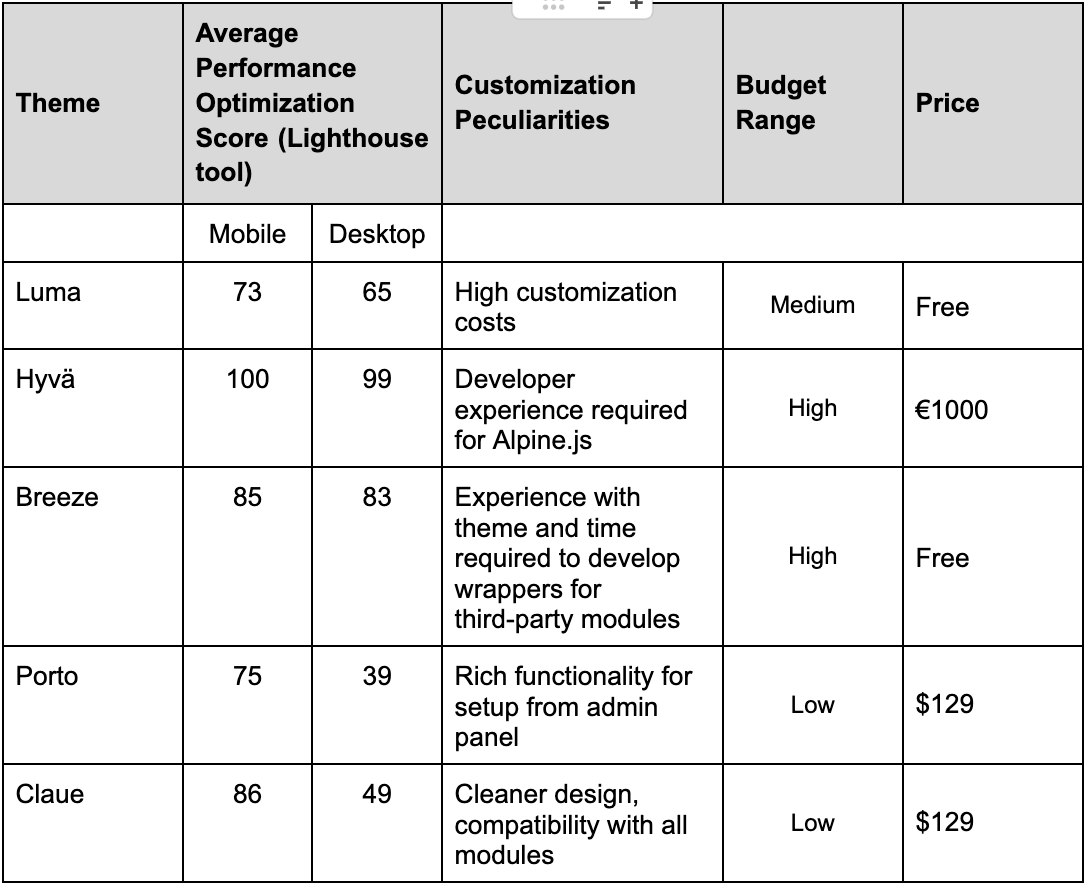
When it comes to performance, Hyvä and Breeze offer the best performance optimization scores with modern front-end stacks, resulting in a more dynamic interface for any Magento 2 frontend. However, they require developer experience to work with, and additional (JS/Tailwind) development effort may be necessary to achieve the best performance results. Luma, Porto, and Claue, on the other hand, offer good compatibility with third-party modules and require less customization effort but are very hard (to downright impossible) to get to desirable performance grades in 2023

In terms of customization peculiarities, Porto offers rich functionality for setting up from the admin panel, while Claue has a cleaner design and good performance. Luma requires a high level of customization costs, while Hyvä and Breeze need additional development effort for the best performance results.

Here’s a summary of the budget range and price of each theme (Prices are relevant on March 2023 and may differ in the future):

  • Luma: Free
  • Hyvä: €1000 
  • Breeze: Free
  • Porto: $129
  • Claue: $129

This table and chart should give you a quick overview and comparison of the key features and specifications of some selected templates of the listed Magento themes. It is worth noting that these selected templates have been tested through the Lighthouse tool (applicable from March 2023) and may be improved in the future.  The performance optimization score is based on the desktop and mobile homepage, category, and product. You can use these comparisons to help choose the theme that best suits your needs and budget for your planned e-commerce website.

In conclusion, choosing the right Magento theme for your e-commerce website requires considering various factors, including performance, customization, budget range, and price. With this information, you can choose the theme that suits your needs and offers the best performance for your e-commerce website. 

April 7, 2023
Interactivated solutions blog banner

How Augmented Reality (AR) Is Changing eCommerce

Augmented reality is gaining popularity across industries, and eCommerce is no different. With more than two-thirds of customers saying they prefer retailers who feature AR experiences, there’s no doubt that this approach can help boost an online business’ performance and sales. But to what extent is this true, and how can you implement AR into your eCommerce channel? This article will try to answer these and many other questions.

How AR Benefits an eCommerce

Let’s start by answering the most basic question. How exactly can an eCommerce business benefit from implementing AR?

1. Greater Customer Engagement

Augmented reality is naturally interactive. This makes it straightforward to hook users to a website. The longer you keep a person on your eCommerce site, the higher your chances of having them convert. Customers who shop online can interact with the products they like much as they do in a physical store. They can try out a piece of clothing or see how a furniture piece would look in their own living room.

This gives merchants the chance to engage with their customers in a whole new way. After all, the customers don’t necessarily have to make a purchase right away. When they develop a positive relationship with your products and brand, they are more likely to return to you in the future.

2. New Customers

It’s becoming more challenging for marketers to bring new paying customers into their sales funnel. If you aren’t creative and don’t create a buzz, you’re far less likely to get someone’s attention. AR brings limitless engaging campaign ideas you can launch to stand out from the competition and attract new customers.

3. More Flexible Product Customization

A single 3D model can be represented in unlimited colors, shapes, patterns, and designs. You can increase your ROI by investing in 3D AR models compared to regular product photographs that require shooting locations, professional photographers, gas money, etc.

4. Faster Product Development

You can even use AR to create new products fast. You no longer need to send sketches to your manufacturer and wait for them to create a prototype. The simple creation of a 3D model will speed up the process. As a result, you can be more responsive to your customer demands and utilize the latest eCommerce trends.

5. Lower Product Returns

A recent UPS study showed that a whopping 27% of consumers return goods because they weren’t as described. This is mainly because most modern-day eCommerce businesses use images and videos to provide information about their products. But AR brings far more opportunities for presenting products.

You can make a 3D view, let the customer see how the product would fit their space, and come up with plenty of other visualization options. This allows the customer to experience the product more realistically, so they’re less likely to return the item because it didn’t meet their expectations.

6. Higher Brand Awareness

Marketing products through innovative AR technology helps build brand awareness and allows customers to connect to the business in a new way. Implementing such an approach will elevate your brand’s status in the customer’s eye as it will provide them with higher confidence about the quality of the product.

7. Higher Conversion Rates

As a result of boosting your brand awareness, keeping people on the website for longer, and increasing customer confidence, you can also expect to have higher conversion rates. Numerous stats show that AR boosts average mobile and desktop shopping conversion rates by up to 40%.

Kickstart the AR Experience in Your eCommerce

You may ask yourself, “How hard is it to bring AR to my eCommerce store?” Well, it’s not as hard as you may think.

Below are steps you can take to make sure the process runs smoothly.

Kickstart the AR Experience in Your eCommerce

1. Set Your Business Goals and Objectives

Before starting the AR experience, you first need to answer some questions. What is your goal with AR? How will implementing it help your customers? Take a few moments and think about the answers, because they can be the make-or-break point of how successful the transformation will be for your business. You need to know exactly how your customers will benefit from this new experience.

So, before you jump into the technicalities, make sure your vision is aligned with the concept of AR. From there, it’ll be much more straightforward to pick the right technologies.

2. Decide on the Tools

The next step is to come up with a list of tools you want to use on your new journey. You should be aware of the following aspects, though:

  • License

Those eCommerce owners with a limited budget should consider AR platforms with free licenses. Premium solutions can get too expensive and may not be worth it at the beginning.

  • Device support

Do you wish to run your AR tool on mobile devices, laptops, tablets, or maybe AR glasses? It’s crucial to select tools that support your preferred hardware.

  • Operating system

Not all AR platforms support all operating systems. If you plan on making a universal AR experience, make sure the tool will work on all major operating systems.

  • Features

Be careful not to choose AR platforms that don’t offer the features you need. Check the feature list carefully before signing up for any plans.

The Marketing Part

After kickstarting a new AR experience on your eCommerce platform, you’ll want to tell the world about it. You can create demo videos, share in-app instructions, and make the content shareable. Give your eCommerce customers some time to adapt to the changes and be active on social media platforms to spread the word further.

How to Use AR in eCommerce Business

So far, we’ve discussed the benefits of using AR in eCommerce and provided an overview of how you can bring this experience to your website.

But now, let’s focus on how exactly different businesses can use AR to optimize their eCommerce websites.

1. Try-On Options

One of the main reasons businesses have a low conversion rate is the fear of the customers that the product they see won’t suit them. An average shopper spends their money wisely and wants to be absolutely sure the T-shirt or dress they have their eyes on will be a perfect fit.

The AR solutions can help online shoppers understand how a product will work for them. This is a particularly useful tactic for online clothing, makeup, eyeglasses, and accessories stores.

For example, Nike allows users to measure their feet and try on the sneakers before ordering. The app claims it can measure every person’s foot individually, including the size, shape, and volume, within a 2-millimeter accuracy.

Sephora is another excellent example where shoppers use their Virtual Artist app to try virtual makeup at home.

2. Placement Preview

Online shopping for furniture can be a daunting experience. Will the bookshelf fit in the corner of the room? Will the TV screen look too big in the living room? It’s almost impossible to answer these questions by solely looking at a new product image on a website. Sometimes, even reading the product dimensions doesn’t paint the picture. But adding placement preview options gives potential customers a real-time view of how a product would fit their home or business.

Placement Preview

For example, a custom furniture brand called Burrow uses this technology to help clients visualize how their new couches will fit their living space. The users rely on an app to place models of sofas on photos taken from the user’s iPhone or iPad.

3. Social Media Filters

Chances are, you have already tried some Instagram Story or Snapchat AR filters. Most social media users enjoy these filters, so more and more brands jump on the bandwagon to get closer to their customers.

By using AR as social media filter, you can showcase your new product in a fun and engaging way and let people test out how it will look on them. Also, the novelty and “wow” factor will help you beat the competition and encourage people to tag you in their Stories. As a result, you’ll spread your brand awareness and get more social media followers.

Important AR Stats in eCommerce to Be Aware Of

Before we wrap up this article, here’s an overview of the most important stats about AR in eCommerce.

  • 52% of retailers aren’t prepared for AR integrations yet.
  • $50 billion is the estimated AR market value by 2024.
  • 71% of customers would shop more frequently if they had access to AR.
  • 40% of consumers would pay extra for a product they can customize in AR.
  • Businesses spent $18.8 billion on AR and VR experiences in 2020.
  • More than one billion people use AR today.
  • 40% of businesses see higher conversion rates.
  • 32% of shoppers rely on AR for shopping.
  • 83.1 million people in the U.S. used AR every month in 2020.

AR Is the Future of eCommerce

Augmented reality has made a huge impact on how people perceive products in online shopping. Numerous filters and product visualization options allow merchants to familiarize potential clients with their offers like never before. This means higher revenue, fewer returns, and greater client satisfaction.

The AR revolution has only started, and we can expect to see its popularity grow in years to come. For now, you can think about how your eCommerce store can benefit from such an approach and see how you can implement it following the tips provided in this article.

March 30, 2023
Interactivated solutions blog banner

The Best Front-End Frameworks for e-Commerce Sites in 2023

The most important aspect of an e-commerce website is its user interface. Buyers won’t stick around long to purchase if a website is difficult to navigate or has a cluttered or uncomfortable look. Nowadays, the average person doesn’t have a very long attention span. If they are immediately turned away by a website because it looks too busy or confusing, that’s a potential buyer who’s going to look elsewhere.

Successful website developers and businesses focusing on e-commerce are aware of the importance of using the best front-end framework. Without an easy-to-use user interface, even the best products advertised on an e-commerce site will be ignored.

What Is a Front-End Framework?

The simplest definition of a front-end framework is that it’s the part of a web application, such as a website, that you’ll see. This could be the website’s design and any parts of it that a visitor can interact with. A front-end framework is typically created by combining three popular programming languages: HTML, CSS, and JavaScript. Modern front-end frameworks are comprised of software that has pre-written code modules, which make it easier to design websites without any knowledge or expertise in code writing.

The most user-interactive part of a website’s front-end framework is the UI (user interface). This is an integral part of all front-end frameworks. This is where the website designer can align elements, designate color schemes for the site, and stylize the HTML elements using CSS. All of these things will help to create a professional and clean-looking site.

The most popular front-end platforms usually use JavaScript. These frameworks need to be interactive, snappy, and fast, which JavaScript provides.

Best Front-End Frameworks for e-Commerce Sites

The front-end framework world continues to evolve and grow. With so many different choices, it’s difficult to stay up to date. If you’re looking to develop an e-commerce website, you’ll want to use a front-end framework that is easy to use. This is especially true if you are new to website design and have little to no knowledge of coding. Fortunately, many of the newest ones have fast learning curves and are easy to navigate.

Bootstrap

Bootstrap is a popular free, open-source CSS framework for front-end website development. It’s easy to use and customize and has a simple file structure, so web developers can build websites faster. Beginners should opt for the precompiled version. However, there’s a source code version available that’s more suited for experienced developers.

Bootstrap comes with a predefined element grid system. This is a major benefit since it saves you from creating one from scratch. You can define each of the rows and columns and then simply add your custom data or functions. Once your grid is fully defined, all you need to do is add your content. It’s compatible with most web browsers which can help to reduce bounce rate.

Svelte

Svelte is another free, open-source front-end compiler but has a much different approach than other similar frameworks. Experienced website designers won’t need to write much code to produce highly interactive front-end frameworks. Since Svelte is a front-end compiler, users won’t need to load the library to a browser to run Svelte’s code. It uses a simple .js file on the page for rendering. This is a great time-saver since the entire library doesn’t need to be loaded, significantly reducing file sizes. All object updates are made at compile time.

Svelte doesn’t have a virtual DOM. Instead, it converts code to a framework-less vanilla JS. This is of great benefit for loading a website on mobile devices. It’s easily scalable and is quicker than most of its rivals.

The Best Front-End Frameworks for e-Commerce Sites in 2023 1

Lit

Lit is a JavaScript front-end framework built for better reactive programming. It’s best at keeping bundle sizes small, which can reduce loading times. Lit works well with other frameworks. This can help when a developer builds complex sites using multiple frameworks. Lit renders quickly and doesn’t need to load changed elements separately. Elements will update automatically whenever their properties change.

With Lit, you can reduce your reliance on boilerplates. With declarative templates and useful features, it makes the creation process much easier. Lit components are standard elements, so browsers treat them as built-in elements. It doesn’t matter how you use them. They can be custom-written in HTML or from your CMS (custom management system).

SOLIDJS

SOLIDJS is another front-end framework built for JavaScript. Similar to Svelte, developers familiar with JavaScript libraries will find SOLIDJS easy to navigate. This one doesn’t use a virtual DOM. Instead, it compiles templates directly to the real DOM. Rendering of components is only done one time. This is achieved by rendering components as normal JavaScript functions. Using JSX, it renders HTML directly in the browser, keeping the process simple yet fast. This is done by using template helpers to handle loops and conditionals. All elements are wrapped in components and rendered when all conditions are met.

Atom

Atom is a front-end framework that’s built with HTML, CSS, JavaScript, and Node.js integration. An interesting feature that comes with Atom is the four pre-installed user interfaces and eight syntax themes which come in both light and dark modes. This can be a time-saver for website designers with quick deadlines. If there isn’t a suitable one, designers can create their themes or upload one from the Atom community.

For designers who prefer more flexibility and want to create a unique style, customizing the feel and look is easy. They can use CSS, HTML, and JavaScript to build and customize. Another option is to choose from the many open-source packages that are built-in.

Angular

For easy-to-build front-end frameworks, Angular is a popular choice. This one is a straightforward user interface framework that’s based on TypeScript. In contrast to other front-end frameworks, Angular uses a two-way data binding trait. Simply put, the real-time synchronization between model and view which replicates information quickly.

Coding with Angular is easier by using refactoring services and enhanced coding navigation. It also has a user interface with single components, creating an easier design process. Angular comes with simple, declarative templates, further ensuring that it’s very user-friendly. These templates can be further extended by adding your own components or by using many of its existing ones.

Foundation

Foundation has a mobile-friendly front-end framework, making it a smart choice for designers whose target e-commerce customers mostly use phones. It’s open-source and uses CSS components. Beginners may have difficulty with Foundation as it’s more built for designers with a background in different front-end frameworks.

Known for quick rendering and smooth animations, Foundation is an advanced but challenging front-end tool. It’s customizable, yet has many resources and code snippets to use. It also comes with pre-built HTML templates to give users an easy starting point.

Considerations for Front-End Frameworks for e-Commerce Sites

The Best Front-End Frameworks for e-Commerce Sites in 2023 2

Choosing the right front-end framework can be a daunting but necessary first step for building the best e-commerce site. With so many frameworks available, it’s important to choose the one that works best for you. Here are several things to consider before diving in:

Server Rendering Times

Knowing your target audience is key when selecting which front-end framework to create the perfect e-commerce site. If your target audience is mobile web users, then choosing a framework that works well with mobile sites and apps is the type you should focus on. You’ll want prospective buyers to easily navigate your site using a phone, so designing with a framework built for mobile use is of utmost importance. Customer retention comes from an easy-to-use user interface.

Flexibility and Scalability

Goals and trends can change quickly in the e-commerce world. Selecting a tool that makes it difficult to quickly upgrade and customize will cause more headaches when it’s time to upscale or make significant changes. A front-end framework that’s not easily customized without a lot of effort and time may not be beneficial, even if the initial setup was easy.

Support

Not all creators and designers are experts at understanding exactly how different tools work. For those who lack experience in the field, choosing a tool that has a fast-responding support team could prove invaluable. Another consideration is to look for ones that have a large online community. This could provide you with much-needed support and assistance at times when you’re feeling challenged.

Coding Time

Tools with pre-written code may be better for designers with little or subpar coding skills. However, these tools may not provide the uniqueness required to build the perfect e-commerce site. Writing code can be a time-consuming process, but the benefits of doing so could outweigh the constraints of time.

Choose Your Front-End Framework Wisely

Maintaining a competitive edge in the e-commerce world is crucial for survival and profitability. For e-commerce businesses, an enticing and easy-to-navigate website is necessary. With the many tools available for front-end frameworks available, careful consideration as to which one is best can ultimately make or break a business.

Decisions should be made based on a designer’s skill level, how complex and interactive the site needs to be, rendering times, and scalability.

March 15, 2023
Interactivated solutions blog banner

Does Ethereum 2.0 Mean the End of Mining?

Ethereum 2.0, the highly anticipated update of the Ethereum blockchain, is expected to make the network more sustainable, secure, and scalable. This massive upgrade will result in switching Ethereum to a new consensus mechanism. But, what does this mean for mining?

With Ethereum’s own website stating that mining will become obsolete after Ethereum 2.0 launches, the future doesn’t look bright for Ether miners. Let’s break down what will happen with mining and what your next steps should be.

What’s Ethereum 2.0?

Ethereum 2.0 is an upgraded version of the Ethereum network that will use a proof-of-stake instead of a proof-of-work consensus mechanism.

The latter entirely relies on mining, with miners using powerful computers to solve complex mathematical equations known as hash functions. This system uses a massive amount of electricity for verifying transactions.

At the moment, Ethereum’s total power consumption is comparable to the country of Portugal, while its carbon footprint matches that of Myanmar. Switching to verifying transactions via staking will drastically decrease these alarming figures, thus addressing one of the most prevalent cryptocurrency criticisms.

The proof-of-stake mechanism will reduce the amount of computational work necessary for verifying blocks and transactions. Instead of solving cryptographic puzzles, coin owners simply need to hold and stake their coins.

Coin owners become validators once they buy and stake coins as collateral. The blocks will be randomly validated, which is a stark contrast to the competition-based mining.

Due to this competitive approach, the proof-of-work mechanism encouraged people to look for any way to gain an advantage. This typically resulted in massive farms of single-purpose hardware equipment, which Ethereum 2.0 aims to eliminate.

When’s Ethereum 2.0 Launching?

The shift to Ethereum 2.0 has been set in motion since late 2020. It marked the first out of the three planned phases.

Phase 0: Beacon Chain

Phase 0 laid frameworks for the subsequent two phases. It was launched in December 2020 by creating a proof-of-stake blockchain called Beacon Chain. This phase aimed to create a central coordination and consensus hub for Ethereum 2.0.

Phase 1: The Merge

Phase 1 aims to merge the current Ethereum Mainnet with Beacon Chain, effectively switching the consensus mechanism to proof-of-stake. This update is expected to roll out in the third or fourth quarter of 2022. According to the developers, the Merge will eliminate the need for energy-intensive mining and start a new era of eco-friendly Ethereum.

As of April 2022, there have been two parallel blockchains, the second being a test chain using the proof-of-stake mechanism. After the Merge, there will no longer be two separate Ethereum networks. There will only be a unified Ethereum blockchain.

The Merge

Phase 2: Shard Chains

The beginning of Phase 2 depends on how quickly the work progresses after Phase 1. At the moment, shard chains are expected to be released in 2023. They will provide more affordable storage layers for rollups and applications, reducing network congestion and increasing the number of transactions per second. The current Ethereum 1.0 chain is expected to become a shard of Ethereum 2.0. In total, the network’s load will spread across 64 new chains.

What Does Ethereum 2.0 Mean for Miners?

Once Ethereum 2.0 ships, the proof-of-work consensus mechanism and, in turn, mining won’t automatically be disabled. In theory, Ether miners could continue their established practices even after the Merge.

However, the Ethereum developers are dead set on completely transitioning to the proof-of-stake consensus mechanism. Having anticipated that many people would choose not to transition to staking, they’ve developed a mechanism called the “difficulty bomb.”

What’s Ethereum’s Difficulty Bomb?

Ethereum’s difficulty bomb will significantly increase the time necessary to mine a new block by making the puzzles in the mining algorithm more difficult. This will, in turn, increase energy usage.

This mechanism is intentionally set to launch in June 2022, shortly before Ethereum 2.0 is released. It aims to do the following:

  • Encourage miners to move away from energy-intensive proof-of-work consensus mechanism
  • Take away the possibility of centralizing currency ownership and creation
  • Force node upgrades
  • Discourage blockchain forks

Simply put, the difficulty bomb is a deterrent that will make mining worthless. Therefore, Ethereum miners risk losing their cash flow overnight as their machines become obsolete. In addition, their GPUs’ resale value is also expected to drop significantly.

As a result, Ether miners will either have to switch to staking or find a different coin to mine.

Currently, there are many different proof-of-work cryptocurrency options for miners. They can transition their graphics cards to coins that are profitable with their current equipment.

Unfortunately, other coins are likely to be less profitable than Ether. On top of that, if a considerable number of miners start seeking new coins, the profitability of these alternate options might decline even further.

What Are the Alternatives to Ethereum?

Ethereum miners can use their consumer hardware to mine several other cryptocurrencies profitably. The most popular alternatives are the following:

Regrettably, these coins are currently not as nearly as profitable as Ethereum. Their profitability fluctuates, but it’s generally 30 to 50% less than Ethereum at any given moment. Also, they have significantly smaller market caps and are listed on fewer exchanges, making their sale more challenging.

But, the biggest downside of smaller coins is their volatility. This means these coins tend to rise and fall much more dramatically than larger coins. As a result, it isn’t easy to choose which coin to mine.

Is Bitcoin a Viable Alternative to Ethereum?

Despite its high volatility, Bitcoin has arguably been the most popular cryptocurrency since its inception.

However, Bitcoin isn’t on the list of viable alternatives for Ethereum miners because of the difference in equipment used for mining these coins.

This cryptocurrency is mined using application-specific integrated circuit (ASIC) miners, so your existing consumer graphics cards would be of no use. Therefore, Bitcoin wouldn’t be the best route to take if the goal is to use the existing hardware equipment.

Nevertheless, you can always invest in their specialized hardware and switch to mining these coins.

Will Mining Disappear Completely?

The mining hash rate is one of the key metrics in measuring the overall performance of miners in a network. The more GPUs mining a specific cryptocurrency, the higher its hash rate.

Ethereum currently has a substantial advantage over the other coins’ total hash rates, meaning most GPUs tasked with mining are used for Ethereum.

As a result, once the Merge takes place and the difficulty bomb is implemented, many miners will look for the next best option. This sudden surge in hash rate will ruin the smaller coins’ profitability due to a mechanism called the mining difficulty.

Mining difficulty is a simple mechanism that ensures a steady block production rate. If its hash rate increases drastically, the network will compensate by increasing the difficulty of solving each block.

So, a massive influx of miners will cause these alternative networks to make it almost impossible to solve a block and receive a reward. If mining takes such a colossal profitability hit, it will likely die off, as miners won’t have any incentive to continue.

Can Mining Be Saved?

With how popular cryptocurrency mining is, many people stand to lose a lot if it ends. Naturally, most miners are eager to continue making money using the hardware they already own.

In theory, the value of alternative coins could rise together with their hash rate if enough people buy and hold them. This would, in turn, lead to them remaining profitable even after the Merge.

The earnings might never be as high as they were with Ethereum, but they could stay high enough to ensure a profit. If running a GPU costs less than the unit earns, many miners will probably choose to continue this endeavor.

Can Mining Be Saved

What’s the Best Route for Miners?

The crypto market is widely unpredictable, so there’s no telling which scenario will occur once Ethereum 2.0 is launched.

Many miners will probably choose to liquidate their hardware to avoid it becoming useless and worthless. It might be prudent to do so before the Merge when GPUs are likely to flood the market.

If a larger portion of miners sells their GPUs, this can open the door to a smaller mining community continuing to make a profit. Profitability might initially take a hit, but the coin prices could eventually catch up with the mining difficulty.

Of course, there’s always the option of investing in staking. This might be the most sensible option, considering it includes the least amount of speculation.

Ethereum holders who switch to the proof-of-stake will pay less for transactions. Also, they can use their existing coins to become validators. Finally, any apps they have on Ethereum will migrate to Ethereum 2.0 with no data or records losses.

To Mine or Not to Mine?

The launching of Ethereum 2.0 will undoubtedly change the course of crypto mining. Although mining Ether will become unprofitable, other mining options might still appeal to you. Alternatively, you can sell your hardware and use the money to accumulate more Ethers and start staking. Consider your choices wisely and do your best to stay ahead in this unpredictable market.

February 28, 2023
Interactivated solutions blog banner

Biggest Cybersecurity Challenges of 2023

The digital revolution has created a heavy reliance on IT to manage the daily operations of businesses and organizations. For that reason, professional cybersecurity is always vital for protection against cyberattacks.

The shift from the office to work from home and hybrid work culture has established a new wave of cyber threats and attack vulnerabilities. In addition, continuous change and new technologies have increased cybercrime and more sophisticated techniques for crime success.

So what’s expected next in the world of cybercrime? We discuss the most impactful cybercrime and challenges businesses and organizations are expected to face in 2023 and beyond.

Smartphone Attacks

According to Google, 80% of the world’s global population use smartphones, and mobile phone use accounts for over 60% of internet fraud. Many leading e-commerce platforms are accessible via mobile. We store everything on the phone, from financial transactions to personal information and communications. Cyber hackers target smartphone users and use mobile devices as the perfect opportunity to commit cyber fraud.

A high percentage of smartphone cybercrime, including viruses, malware, data loss, and tampering originating from the smartphone, is set to continue to rise well into 2023. Virtual Private Networks (VPNs) and mobile virus-scanning apps can help circumvent attacks.

Geo-Targeting Phishing Threats

Phishing attacks are the IT industry’s most prevalent security risk, and many are still victims of phishing emails. Cybercriminals use advanced techniques to develop well-executed business email compromise (BEC) attacks. In addition to phishing emails, malicious URLs stay rampant on the internet with added sophistication for a more believable attack. They are now more personalized, highly localized, and geo-targeted or location-based targeted.

Other lure tactics include imitating local brands and using grammatically correct local languages. Many users have been acclimatized to believing they can recognize scams through incorrect grammar and poor spelling, which increases the likelihood of them falling for well-constructed scam messages.

Security of Remote and Hybrid Workforces

During the COVID-19 pandemic, nearly all businesses and industries adopted a new work culture, either working remotely or a hybrid model. This new work model has become the norm. Network protection in organizations that serve to safeguard against cyber threats is nearly impossible using this new arrangement. Since employees connect using an open Wi-Fi network from anywhere, it’s increasingly challenging for organizations to ensure security and confidentiality.

Remote working is here to stay, and recently, businesses have taken significant strides to restrict emerging cyber threats. However, completely securing remote and hybrid working environments will remain a challenge for cybersecurity as cloud-based attacks are increasing significantly.

While cybersecurity professionals work on how to combat the security vulnerabilities of remote working, here’s how you can reduce the risk of phishing, ransomware, and social engineering attacks when working remotely:

  • Use secure internet connections and VPNs. Avoid working on public Wi-Fi without a backup.
  • Use strong and unique passwords for all your systems.
  • If you haven’t already, adopt a zero-trust approach where you presume all devices and users are potential attackers.

Cloud Security

Due to efficient cloud management software, there is a steady rise in businesses and organizations migrating to cloud services. Accessing data from anywhere supports the new remote and hybrid working style. However, it also makes it easier for cybercriminals to access your information.

IT security professionals need to focus on tightening cloud security, and clouds need continuous monitoring and updating to safeguard from data leaks. While common cloud apps like Microsoft and Google are well armed with security at their end, the user’s end is a significant source of errors, phishing attacks, and malicious software.

Biggest Cybersecurity Challenges of 2023 1

IoT 5G Network

The introduction and growth of 5G networks are in preparation to support the Internet of Things (IoT), the new age of interconnectivity. However, communication between multiple devices leaves them susceptible to vulnerabilities from attacks, outside influence, or unfamiliar software bugs.

Software bugs are not uncommon; even the top-rated web browser Google Chrome was found to have serious bugs. In comparison, 5G architecture is new to IT, and lots of research is necessary to find all the loopholes to secure it from cyberattacks. Software and hardware manufacturers must be meticulous and sophisticated in building hardware and software to control data breaches.

Other security challenges associated with 5G include:

  • 4G and 5G co-existence require consistent and enhanced performance security.
  • Virtualization introduces new risks.
  • Additional devices and bandwidth required to support 5G also support cybercrime.
  • Distributed edge clouds encourage new attack surfaces.
  • Manual procedures are insufficient to prevent threats.

Deepfake Technology (AI)

Rapidly evolving tech deepfake is an Artificial Intelligence (AI) based technique for producing authentic-looking fake videos. Deepfakes generate fake events or news stories to damage a reputation. Deepfakes can also potentially be used in cybercrime to spread malware or create phishing attacks.

An example of a deepfake attack occurred when the CEO of a British energy company received a call that he mistook to be the head of the company’s German parent company. The CEO was fooled into thinking his boss was asking him to transfer thousands of dollars to a Hungarian supplier’s account. This deepfake tech mimicked the boss’s precise tone, variation, and slight German accent.

Ransomware Attacks Advancement

In recent years there’s been considerable growth in ransomware against organizations and individuals, which doesn’t appear to be slowing anytime soon. Cybercriminals threaten to circulate their victim’s data or block access to valued files or data until the ransom is fulfilled. Data suggest that approximately $1 billion was paid as ransomware in the U.S. during the 2021 first quarter. And it’s projected to increase. As a result, more individuals and businesses are at risk.

Firmware Attacks

Firmware attacks are a form of cyberattack that targets firmware. Firmware is software kept on a device’s read-only memory (ROM). This attack allows cybercriminals to gain control over a device or its information and can be problematic to identify and defend.

These attacks target any device with firmware installed, including routers, IoT devices, and computers. An example of a firmware attack is "badUSB." This attack turns a USB device into a "keyboard" by reprogramming the USB’s controller chip. It lets the attacker send keystrokes to the victim’s PC to allow the attacker to control the computer or install malware remotely.

Unfortunately, many organizations undermine firmware security, and firmware attacks are likely to increase and become more sophisticated. Industries experiencing the most firmware attacks should implement an efficient hardware-based malware protection strategy.

Increased Automotive Hacking

Many modern vehicles are equipped with automated software for seamless connectivity to advanced systems for driving assistance. These vehicles use Bluetooth and Wi-Fi tech for communication, but this setup opens several vulnerabilities or threats from hackers.

With more automated vehicle use, hackers gaining control of vehicles or eavesdropping on conversations via microphones is expected to rise during 2023. Self-driving or autonomous cars use complex processes that need stringent cybersecurity measures.

Biggest Cybersecurity Challenges of 2023 2

Automation and Integration

Due to the size of information multiplying by the day, automation must be integrated for more advanced control over data. Today, hectic work demands pressure engineers and professionals to deliver fast and intelligent solutions, making automated systems more of a necessity now than ever.

Security measurements are included during the IT agile process to develop more secure software in all facets. Large and complicated web apps are more challenging to protect, making automation and cyber security key areas of software development.

Political Attacks

Moving into 2023, we have an unstable political landscape. Russia’s invasion of Ukraine resulted in a cyberspace war, with Russian hackers allegedly initiating attacks against Ukraine and its supporters.

More standard and advanced attacks from pro-Russia groups are expected. For example, KillNet, a pro-Russian group, allegedly attacks banks in NATO-aligned countries.

Stopping orchestrated attacks is difficult. However, the best protection is to carry out frequent penetration testing. Seek out system weaknesses and address them immediately. Attackers need only one vulnerability to access a system and cause significant damage.

Critical Infrastructure Attacks

In the cybercrime world, "bad actors" always want more, and they go after more prominent and impressive targets like, for example, taking an entire city offline. In 2023 more attacks on businesses linked to critical infrastructure are expected.

Consider how you’ll deal with such attacks whether you’re in the healthcare or energy industry or loosely associated with them.

Cybersecurity Challenges in 2023

IT has become significantly valuable in our daily personal and business lives. However, technological advancements are like double-edged swords. Progression introduces new security holes and more opportunities for sophisticated cybercrime. For example, remote working capabilities, cloud-based apps, and new tech like IoT and AI offer more cybercrime prospects than ever before.

In 2023 and beyond, businesses and organizations are expected to spend more on safeguarding their infrastructure and assets. Several recommendations for taking proactive measures are recommended to up your security game. Options for tighter IT security include continuously working with cybersecurity experts for network infrastructure evaluation, regular penetration testing, and investing in IT security training for staff.

February 15, 2023
Interactivated solutions blog banner

Unit Testing What It Can Do for Your Business and How to Optimize It

You may rely on a wide array of technologies to run your business. Unit testing may be one of these. It’s a crucial step for streamlining your code and lowering the risk of failed projects. Without it, you might not identify bugs on time and meet your software requirements.

Let’s see why unit testing is so important and how you can take it to the next level.

What Is Unit Testing and What Are the Advantages of Unit Testing?

Unit testing is a software process that inspects individual components or units of your programs. The goal is to make sure each part of your code works correctly. It takes place during your coding (development) phase and isolates code sections to verify their operation. These sections can be objects, modules, procedures, functions, or methods.

Launching your platform without unit testing is incredibly risky. You’d miss out on several benefits:

Bug Detection

Bugs can ruin your chances of successful deployment. Thankfully, you can use unit testing to catch these issues before they wreak havoc on your production. By testing individual code units, you can recognize and address bugs to avoid releasing them into your production environment. This way, you can make sure your software works properly and correct any problems.

Another great thing about unit testing is that it can lower the time necessary for debugging. It allows you to tackle the issues in the pre-production stage, where solving them is much easier than after the release. This improves the quality of your code and speeds up your launch.

Reduced Need for Manual Testing

Keeping your developers happy is one of your main goals. Unfortunately, they can become dissatisfied with their workplace if they constantly revise code manually. They need to make sure bugs don’t make it to quality assurance, but they could use an automated way to do so.

That’s where unit testing comes in. Your programmers can avoid manual testing by using a robust framework that does most of the work for them. Consequently, they don’t have to waste time digging through endless lines of code. This boosts their productivity while minimizing the chances of bugs.

Source of Valuable Documentation

Unit testing enables you to document your code and help other team members understand the software. Writing these tests helps explain how each code unit behaves, allowing you to set up dynamic documentation others can reference.

The paperwork is particularly useful when working with other programmers. It lets them quickly figure out how different pieces of code act in certain environments, eliminating the guesswork associated with this process.

Polishes Software Design and Higher Revenue Potential

Performing a unit test forces you to reconsider your design and determine what you must accomplish before writing the final version. This improves focus and helps you come up with a better design.

A bug-free app translates to higher customer satisfaction and loyal users. If your customers support your software by recommending it and leaving positive reviews or sharing it with others, your revenue potential soars.

Moreover, having a polished system decreases the number of critical reviews, which might be even more significant than having many positive reactions. Some people specifically look for negative reviews to avoid flawed products or services. Consequently, the fewer damaging reviews your app has, the more money you can make with your software.

How to Optimize Your Unit Testing

Unit tests can do a world of good for your business. But like any other procedure associated with software development, there are ways to maximize its efficiency:

Unit Testing What It Can Do for Your Business and How to Optimize It 1

Take Your Time with the Testing

Unit testing allows you to verify the functionality of various coding scenarios. For instance, you can use this method to make sure you’ve resolved a bug, and that all features work adequately. You can diagnose many variables, but the key is to go one scenario at a time.

The strategy allows you to isolate certain parts of the program that may contain the problem if your testing fails. Uncovering bugs is much easier this way because you don’t have to check several scenarios at once. There’s less uncertainty, and you can recognize the issue more quickly.

Determine the Right Scope

You can view your unit testing as your insurance policy. It safeguards your project from failure by detecting bugs on time, which allows you to resolve them before they affect other parts of the system. Depending on your risk tolerance, you may want to buy more or less insurance.

In software terms, this means you should choose your unit testing structure according to how extensive you want your analysis to be.

For instance, you might want to be as comprehensive as possible. You won’t mind spending more to provide maximal coverage of your code to avert a disaster.

You could also belong to another group of business owners who like taking their chances. You might be financially resilient, allowing you to rebound from losses without damaging your reputation.

However, neither approach is perfect. The problem with the first one is that it typically takes too long. The other method is too risky, especially if you have limited resources – even a small loss can hinder your operations.

Hence, you might want to consider finding a middle ground. Rather than analyzing the entire code sequentially or ignoring your unit testing altogether, only focus on the critical parts (targeted unit tests).

This method is convenient because most projects come with time and financial restraints. It enables you to cherry-pick your code and zero in on the elements crucial to the success of your programs. Accordingly, you’re less likely to strain your resources or waste too much time scrutinizing irrelevant units.

Abandon Test Interdependence

You don’t need to cover the entire code when running a unit test. The technique lets you check fewer lines to validate individual units. For this reason, you don’t want to utilize test interdependence.

This term refers to the situation where one unit of your test hinges on the outcome of other units. If one fails, the entire system follows suit.

Hence, don’t take a chance with interdependent units. Analyze units individually and put each one in a single class.

Automate the Process

Your unit testing should be largely automated to allow for analysis on an hourly or daily basis through a continuous integration (CI) and continuous delivery (CD) process.

Another great idea is to configure the procedure to make sure the entire team can access your reports. It enables them to discuss key points, such as the number of runs, coverage, performance, and modified coverage.

Unit Testing What It Can Do for Your Business and How to Optimize It 2

Check if Your Tests Are Scalable and Repeatable

You can make the most of your unit tests if they’re scalable and repeatable. To deliver such a system, establish a set of robust practices to ensure your team members can write the tests while writing your application code. You can also consider writing the tests before the application code if you’re performing test- or behavior-driven programming. Either way, you should design the tests while keeping your application code in mind at all times.

In addition, don’t forget to assess your tests and app code together during your review process. This gives you an insight into your code, enabling you to streamline the software. It’s also important for changes, planned updates, and bug fixes.

Lastly, don’t tolerate failures. You’ll have little use for your testing results if your developers ignore the failures. Testing failures indicate real issues, alerting your team they should address them immediately to avoid wasting time on bugs or transferring bugs to the production stage.

Continuously Refactor the Code

As you reach broader audiences with your code, you must expand your platform to respond to the higher demand. As the system grows, your code must follow suit.

Some insist that altering your tests is ill-advised because it could break your testing environment. However, that might not be the case.

Refactoring your code lets you find a better code arrangement within the production code and get a better understanding of how to adapt it to certain settings. This can be beneficial in several ways. For example, it tells you if there’s any duplicate code, allowing you to optimize your maintenance by removing unnecessary content. You can implement more relevant solutions to streamline and clean up your code whenever you find a good solution.

Therefore, refactoring your test code is critical. But as you’re making changes, you should bear one thing in mind - keep your code simple. This doesn’t mean being reckless. It means you should make your code easily understandable. As indicated above, you should remove unnecessary content (e.g., duplicate code) for straightforward maintenance and faster error detection.

Don’t Leave Your Software Development to Chance

First impressions matter most when rolling out an app. That’s why unit testing is so important. By allowing you to dissect your code and recognize bugs on time, it lets you make the necessary changes to enhance the system. This can translate into higher customer satisfaction and greater revenue potential.

January 15, 2023
Interactivated solutions blog banner

Proof of Stake vs. Proof of Work: Explained

Proof of stake and proof of work are the two most common methods of verifying cryptocurrency transactions today. If you’re new to the world of cryptocurrency, you might be wondering how these mechanisms differ.

Since proof-of-stake and proof-of-work methods are the cornerstones of blockchain technology, understanding how they operate is fundamental to understanding this mechanism.

With that in mind, let’s dive into how these mechanics work and their pros and cons.

Proof of Stake vs. Proof of Work

Proof-of-stake and proof-of-work methods have one thing in common. They are both consensus mechanisms. As the name suggests, they aim to reach a consensus among the network users on which blocks of transactions will be added to the blockchain. Achieving consensus ensures that the users are honest with transactions and that the transactions are legitimate.

However, the difference between these two mechanisms lies in how they reach this end goal. These different methods of achieving consensus have pros and cons, which can be crucial in deciding which to use.

Proof of Stake vs. Proof of Work: Basic Principles

Proof of work was the first consensus mechanism to be used, as Bitcoin, the first cryptocurrency, employed it. This method relies on “mining” or solving complex mathematical equations to add valid blocks to the chain.

Each transaction block contains the following:

  • Block difficulty
  • MixHash
  • Nonce

Miners use massive amounts of computational resources in a race to find the nonce for a block. The nonce is a value generated only once for that specific purpose. Together with the mixHash, it guarantees a sufficient amount of computation has been carried out on a particular block.

As a result, it’s easy for other miners and clients to verify it. Once the block becomes a part of the chain, anyone with an internet connection can view it. The miner who’s added the block can be rewarded by earning cryptocurrency.

Regarding proof of stake, validators add new blocks to the chain instead of miners. Users can stake their coins as collateral, thus voting for the block they think should be added to the chain. Validators are selected randomly from the pool of users who’ve purchased and staked coins and have the final vote on which block is added.

Validators are paid over time with the newly created currency as a reward for approving legitimate transactions. In contrast, if a validator acts dishonestly, their stake can be destroyed.

Proof of Stake vs. Proof of Work: Profitability

Currently, the proof-of-work is the only mechanism to have been proven to be profitable on a large scale.

Most major cryptocurrencies have used this method since their inception, including the following:

However, an increasing number of platforms are using the proof-of-stake mechanism, the most notable being the following:

Unfortunately, none of these platforms have been around long enough to demonstrate their effectiveness and profitability in the long run.

But, it should be noted that Ethereum is in the process of transitioning from proof of work to proof of stake. This monumental transition will undoubtedly impact the profitability of both mechanisms, considering that Ethereum is currently the only mainstream blockchain besides Bitcoin.

Proof of Stake vs. Proof of Work: Security

Under the proof-of-work system, the more difficult a block is to mine, the more time, energy, and resources are used. These significant investments make it extremely difficult for bad actors to verify invalid blocks, erase transactions, or engage in double-spending. Simply put, the resources spent trying to “attack” the system far outweigh the gains a malicious miner would receive.

Most importantly, this method’s security has been substantiated, with Bitcoin safely storing over $1 trillion in value at multiple points.

In contrast, the proof-of-stake mechanism isn’t as extensively vetted compared to its competitor. Therefore, there’s still a debate about how secure the proof-of-stake mechanism is.

As there are no costs of forging, users have nothing to lose. This makes it easier to influence the protocols and tamper with competing blockchain branches. Susceptibility to attacks significantly decreases the overall security of a blockchain.

Proof of Stake vs. Proof of Work Security

Proof of Stake vs. Proof of Work: Environmental Impact

The proof-of-work consensus mechanism is to blame for one of the most prevalent criticisms of cryptocurrency: its detrimental effect on the environment.

At its core, mining is a race for who can solve complex mathematical problems the quickest. As a result, miners tend to look for any way to gain an advantage. This includes running powerful computers 24/7 and establishing massive farms of hardware equipment.

Running these farms leads to alarming amounts of power consumption. In fact, the electrical energy consumption of the leading networks like Bitcoin and Ethereum can be compared to that of a whole country. According to some estimates, mining Bitcoin requires the same amount of power as the country of Argentina, while Ethereum is comparable to Qatar.

Moreover, the miners are always looking for more computing power and disposing of outdated systems. This excessive use of single-purpose hardware equipment results in massive electronic waste.

Since the proof-of-stake mechanism doesn’t rely on mining and machines, it’s drastically more environmentally friendly. Furthermore, this method was developed in response to the high computational costs and power consumption of proof-of-work protocols.

Proof of Stake vs. Proof of Work: Centralization

Decentralization is a defining characteristic of the most prominent cryptocurrency platforms. Still, users can find a way to concentrate power in one place.

The proof-of-stake mechanism has been criticized for being less decentralized and democratic. Although validators are chosen randomly, the system favors those with the most money, entrusting them with creating new blocks. On top of that, there’s no limit to how many coins a single validator can stake in certain cryptocurrencies.

In contrast, anyone with a computer and internet connection can earn rewards under the proof-of-work system, creating an open competition. As a result, block creation is better distributed and the process more decentralized.

Imagine individuals with vast computing power trying to centralize block creation. In that case, miners can pool their resources together and compete for the rewards.

To be fair, validators can also pool their money together to compete with wealthier validators. This process is called a staking pool, which aims to help prevent centralization.

Proof of Stake vs. Proof of Work: Scalability

Scalability is one of the most important characteristics of a blockchain, and it primarily refers to its transaction speed. For a blockchain to be scalable, it must be able to handle a large number of transactions per second without compromising the network’s security.

Proof-of-work networks lack scalability, as blocks take a lot of time and energy to be verified. Since the proof-of-stake mechanism doesn’t involve solving complex, time-consuming equations, it can approve transactions significantly faster.

To put this in context, Bitcoin can carry out between three and seven transactions per second, while Avalanche can complete 5000.

The cost of transactions is another vital element of scalability. Proof of stake also wins this battle, thanks to considerably less expensive transaction fees.

Proof of Stake vs. Proof of Work: Initial Investment

Proof of stake requires a considerable initial investment, as you must purchase enough coins to qualify as a validator. The specific amount depends on the platform you’re using. Regardless of the amount, wealthy people generally have a significant advantage.

With cryptocurrencies rising in market value, this issue could worsen, creating exclusively rich blockchains.

As for proof of work, you don’t have to have any coins to get started. But, you need to invest in computing equipment, unlike with proof-of-stake.

Still, the proof-of-work method requires a lower initial investment because users could start with more affordable hardware and work up to powerful equipment.

Proof of Stake vs. Proof of Work: Penalization

The proof-of-stake consensus mechanism has strict measures to incentivize good actors and penalize bad ones. If a user tries to commit a fraudulent transaction, a percentage of their staked tokens can be destroyed. This penalty is known as slashing. This way, users have an economic incentive only to approve valid blocks.

While it can be costly and time-consuming for proof-of-work miners to engage in similar activities, there’s no way to penalize them if they do. Since mining is inherently anonymous, it’s impossible to confiscate a malicious miner’s equipment or ban them from the network.

Reaching a Consensus

No system is inherently perfect, so the proof-of-stake and proof-of-work methods have many advantages and disadvantages. Now that you understand how these consensus mechanisms operate, choosing the best based on your priorities is up to you.

If neither system appeals to you, it’s best to wait and see what the future holds. While both mechanisms outlined in this article will probably be present for a long time, this doesn’t mean they won’t get any trustworthy competition. After all, developers are constantly coming up with new methods to verify transactions and achieve a consensus on a blockchain.

December 30, 2022
Interactivated solutions blog banner

Certified BigCommerce partner level

Interactivated has reached the Certified BigCommerce Partner level and now has officially re-trained some of our finest specialists for BigCommerce custom development to take our clients onto the next generation of OpenAPI/OpenSaaS E-commerce in the Cloud.  

Working with BigCommerce has been a huge milestone as it has brought manageability and ease. There has been great benefits from the no upgrades, updates, and other costly maintenance. We are super excited about the journey we have completed, and even more excited about the one ahead. BIG has proven itself an unbeatable Cloud Ecommerce player for Headless, B2B, Composable Commerce, and just good old Ecommerce of any sort and size.

BigCommerce is an OpenSaaS and OpenAPI that allows us to do almost anything imaginable. This means we have more freedom in customization and in terms of what we are allowed to do with their APIs.

Benefits of OpenSaas and OpenAPI

Enterprise software has undergone numerous significant advancements in terms of its development, distribution, and application over time. In an effort to enhance user experience and cost-effectiveness, high-tech companies now host their cloud-based applications on their systems. In essence, this sector has risen tremendously.

There are numerous benefits of OpenSaas and OpenAPI; 

1. Increase in functionality

To increase their software’s return on investment, developers are constantly seeking for ways to improve its functionality. Your present SaaS solutions will be more valuable if you have a public API-based tool, and it will also help you draw in more customers and developers.

2. Solves user issues

Businesses typically develop solutions to address a specific issue that one of their clients is having. However, there are situations when a product may not answer all of the present problems. Opening up and inviting other product developers such as BigCommerce integrate with your SaaS product is the optimum course of action. A higher retention rate and an improved general satisfaction rating will be the outcome.

3. Promotes Growth

Numerous developers can increase the value and utility of your SaaS product without incurring additional costs by utilizing the open API.

4. Produce Endless Possibilities

Creating and having access to multiple features that would enhance user experience would be highly beneficial in developing software. Brands have improved clients’ purchasing experiences by utilizing e-commerce SaaS suppliers to give them necessities for example shopping carts.

We would like to congratulate our retrained specialist and developer Oleh Beliaiev who passed and has been certified in the Big Dev Boot Camp exam.

Want to see what BigCommerce could do for your brand and how it avoids many of the limitations that we know from the other most popular Ecommerce Cloud solutions? We are pleased to provide you with a free of charge and obligations demonstration and tour. Just send us a message and we get the demo date planned!

Find out more about our partnership with BigCommerce in the link below.

https://partners.bigcommerce.com/directory/partner/1279061/interactivated-ecommerce-bv

December 28, 2022
Interactivated solutions blog banner

Job Openings - Developers, System Analysts & Sales Specialists

Developers and System Analysts

  • Proactive
  • Strong in communication
  • Great English, spoken and written (Fluent)
  • Smart and well educated (Bachelor in computer science ’level’ as minimum)
  • Team player
  • Positive mindset
  • Self-motivated/driven remote worker
  • Experience in IT and web development for 5+ years (with the tech we are searching for on each job)
  • Ready to sign NDA and to pass a supervised skill test during the interview where we are targeting ’expert’ level, not ’average’

The technology or specialty we are looking for;

  • Python/Django/Flask/FastAPI
  • Typescript/React/Vue/Node Fullstack or Frontend dev
  • System Analyst / QA
  • Magento2 / Adobe Commerce developer Fullstack

Interested in this position? Send us your application with CV to [email protected]

Sales Genius wanted for web dev team:

  • Proactive
  • Positive
  • Team player
  • Experienced in sales / BDM for Web Development, Ecommerce, SaaS sales of services
  • Can bring new sales channels and approaches to the table that will expand our reach further
  • Speaks fluent English and Dutch (German/French are plus)
  • Inbound/Outbound sales OR "Guide" (preferring the latter)
  • Business Development Management
  • Strong managerial skills
  • Self Motivated
  • Happy to visit networking events or represent the company with a boot on such events (f.ex ’Webwinkel vakdagen Utrecht’)
  • Fully Remote
  • Work with international teams
  • Collaborate with the CEO in Spain (remotely)
  • Fully Remote
  • Work with international teams
  • Collaborate with the CEO in Spain (remotely)

Interested in this position? Send us your application with CV to [email protected]

December 17, 2022
Person avatar
Person avatar
Person avatar
We're Ready When You Are

Our expert team is on standby - day or night - to talk timelines, budgets, and bring your idea from concept to launch - seamlessly. No stress, no delays.

Let's Figure This Out Together

Let’s Talk & Build Something Great.

Whether it’s a scalable SaaS platform, an innovative marketplace, a cutting-edge eCommerce solution, or another bold new tech idea, we bring the expertise to make it real - seamlessly and stress-free.No drama, no fluff - just damn good digital solutions.

Interactivated solutions contact person

Roy Van Eijsselsteijn

CEO | Head of Business Development

Write a message

By submitting this form, I agree to the processing of my personal data as described in the Privacy Policy.

This site is protected by reCAPTCHA, and the Google Privacy Policy and Terms of Service apply.