
Your customers’ expectations grow as they buy more and more products and services. They require an interactive experience to understand your offerings better. That’s where augmented reality (AR) comes into play.
AR can add tremendous value to your clients’ eCommerce journey. This article will explain how by listing the most popular examples of AR implementation.
What Are the Most Famous Examples of AR in the eCommerce Experience?
AR is a staple of many eCommerce platforms. It’s helped numerous brands take their website experience to a whole new level.
Converse Sample
Converse is one of the first companies that have applied AR to boost eCommerce sales. They developed the Sampler app that enables clients to try on various pairs of shoes. It also has an integrated purchasing feature that allows customers to buy products seamlessly.
Many other brands have followed in the footsteps of Converse, taking a similar approach to selling sneakers online. The sales process is challenging for any company, especially in the digital sphere, which is why Sampler is even more impressive. It allows for many personal details, – including preferred designs and the ideal shoe size – that let customers view products from their perspective.
Sephora Virtual Artist
A few years ago, Sephora launched the Virtual Artist platform. It allows clients to virtually test a wide array of makeup items. Best of all, a customer can try the product on their own face for a more personalized experience.
Initially, customers had to upload selfies to check out different makeup products before buying them. Recent updates provide a real-time rendering of the items using the customer’s smartphone. Users can test expressions, and angles, and take photos to share with their friends.
Some makeup professionals consider this an inadequate way of matching a shade to a customer’s skin tone. However, the feature still allows users to easily test out options before purchase.

Nike’s SNKRS
Joining a community of rare sneaker aficionados can be incredibly stressful. Every year, fans vie for limited-edition Nike shoes, and sometimes, the enthusiasm escalates to a physical situation. The company wanted to prevent this trend by turning to AR.
Eventually, they came up with SNKRS. This isn’t a typical internet shop. Instead, it’s an AR experience that lets users unlock rare sneakers in NYC by taking pictures of stores or posters or visiting certain locations. Considering Nike’s popularity, this means limited kicks are only reserved for the most avid fans.
The company follows up the app with an annual SNKRS day. This is when Nike re-releases the hottest sneakers of the year to further streamline the shopping experience.
Gucci Virtual Shoes
Converse spearheaded the trend of trying on shoes digitally. As previously mentioned, many companies followed suit, and one of the most famous examples is Gucci.
They’ve made some of their products available only online. Customers can wear and buy them, but on the internet only. As a result, they can customize them with immersive features to create a unique pair of shoes.
This footwear is available on Gucci’s Sneaker Garage. It can also be worn on many compatible apps, such as VRChat and Roblox.
View in My Room by Houzz
Home redecorating and improvements are fun, but they can also be overwhelming. Customers need to ensure their floors match other parts of the house. Plus, they need to determine the right amount of material.
Houzz addresses these concerns by allowing their customers to lay out new floors using View in My Room. This AR-powered app lets customers choose from a vast collection of tiles to find a product that suits their abode perfectly. Once they pick the right design, they can change the tiles’ orientation to achieve the desired layout. Finally, the app calculates the number of squares the client needs to redo their floor.
The platform is an excellent choice for large projects. It lets users share 3D creations with contractors, family members, and friends. Therefore, they can consult other people on the best solution for their house.
Machine A
The coronavirus pandemic forced event organizers to reconsider how they engage with their customers through digital channels. In-person gatherings were frequently canceled at the last moment, which cost companies a lot of money. Businesses had to rise to the occasion and offer a virtual solution for various sectors, especially the fashion industry.
To that end, Machine A was developed. This virtual boutique lets shoppers check out the latest products from the current fashion season. It’s a digital-only setting that works great for remote customers. Even though the original version didn’t feature a shopping feature, it was quickly incorporated and further optimized the eCommerce experience.
Many famous companies integrated with the app due to its potential to plan future fashion events. For instance, Vogue utilized the platform to promote its collection at London Fashion Week. They hosted a seamless event, and audiences observed it from their smartphones.
The platform doesn’t have applications in the fashion world only. It can also be leveraged for electronics or motor shows. For example, Volkswagen took a similar approach to organizing one of their most recent motor shows. They used an AR app to display advanced vehicles digitally, allowing customers to tune in from anywhere in the world.
Amikasa
Amikasa is an AR eCommerce app that lets customers design their dream house with furniture from real-life brands. This makes it perfect for customers redesigning their place or moving into a new dwelling. It enables them to recreate their abode, change colors, and pick the most suitable elements for each room. As a result, they can see whether something fits the layout of the house or makes the area feel cramped. Visualizing the end result is much easier this way.
If customers are happy with the look of their new house, they can purchase products within seconds. The buying feature is streamlined and doesn’t overwhelm clients with unnecessary information.
Quiver
Optimizing the eCommerce experience requires you to cater to all ideal customers, including kids. Quiver is an excellent example of a child-friendly AR app. It’s a simple yet highly effective platform where young ones can download and print a huge array of coloring pages. Once a child has colored their picture, they can bring it to life through Quiver.
The end result is terrific. More and more kids are attracted to the app because it offers an engaging playing experience.
Shopping Lenses
Snapchat isn’t just an established social media platform. They also take business collaboration seriously. enhancing their eCommerce journey with Catalog-Powered Shopping Lenses. It allows brands to utilize AR at scale.
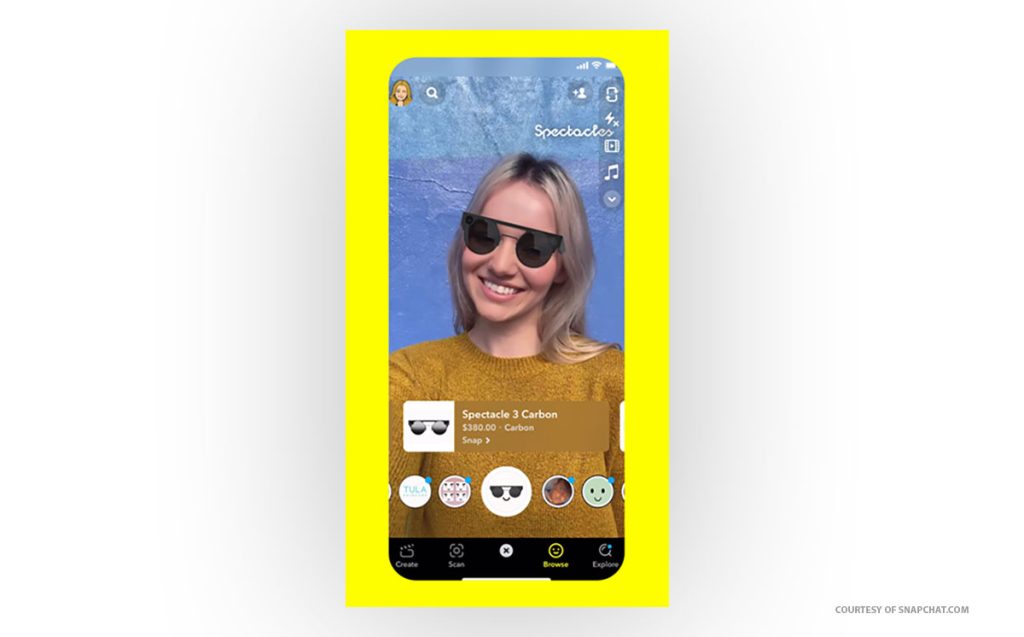
This new platform combines the performance and personalization of AR with commerce catalogs to create immersive product visualizations. It displays multiple items from a brand’s catalog using just one lens. From there, the product information is pulled from a database and visually presented in a new window. Whenever the collection is updated, the changes are automatically shown to expedite the integration process.
Nike’s Gamification
Nike makes another appearance on our list with a different AR program. The company hosted a challenge in one of its NYC stores. Collaborating with Hovercraft, a cutting-edge technology provider, the shoe business set up an engaging gamified discovery center. Shoppers could interact with virtual wildlife while progressing through several AR-based tasks. They were accompanied by a revolutionary AR mascot wearing clothes from the All Conditions Gear collection.
The initiative was a resounding success. Both online and brick-and-mortar sales soared.
Walmart and Zeekit
Walmart has ramped up its AR functionality for its customers. The company recently integrated with Zeekit, an AR fitting room where users can try on various clothes and share their new attire with friends.
The corporation has also optimized AR features for employees. Walmart distributed the new Me@Walmart app to more than 700,000 workers. Each received a new smartphone that supports the platform, providing them with many state-of-the-art features. For instance, workers can now retrieve products from databases faster because it highlights which items are available.
Both Zeekit and Me@Walmart facilitate a better eCommerce experience. The employees can work in an improved, AR-supported environment while the customers enjoy higher immersion.
Salon
Amazon is known for engaging platforms, and one of the most impressive additions is Salon. This 1,500-square-foot space was opened in London in 2021 and was designed to test cutting-edge hairdressing technology. Shippers can try virtual colors and take advantage of the ultra-powerful point-and-learn functionality. It allows customers to point smartphones at a product to obtain relevant information, such as educational content and brand videos. The details appear on the users’ displays.
To purchase a product, all they need to do is scan the appropriate QR code, visit the information page, and finalize the transaction. The items are then delivered to the customer’s home.
Take Your Internet Shopping Features to New Heights
If you want to elevate your eCommerce functionality, there’s no going wrong with AR. Thousands of brands have implemented the technology to make their offerings more accessible to customers and boost sales. You can do the same. Determine what your current platform lacks and look for an app that will elevate the experience.


